

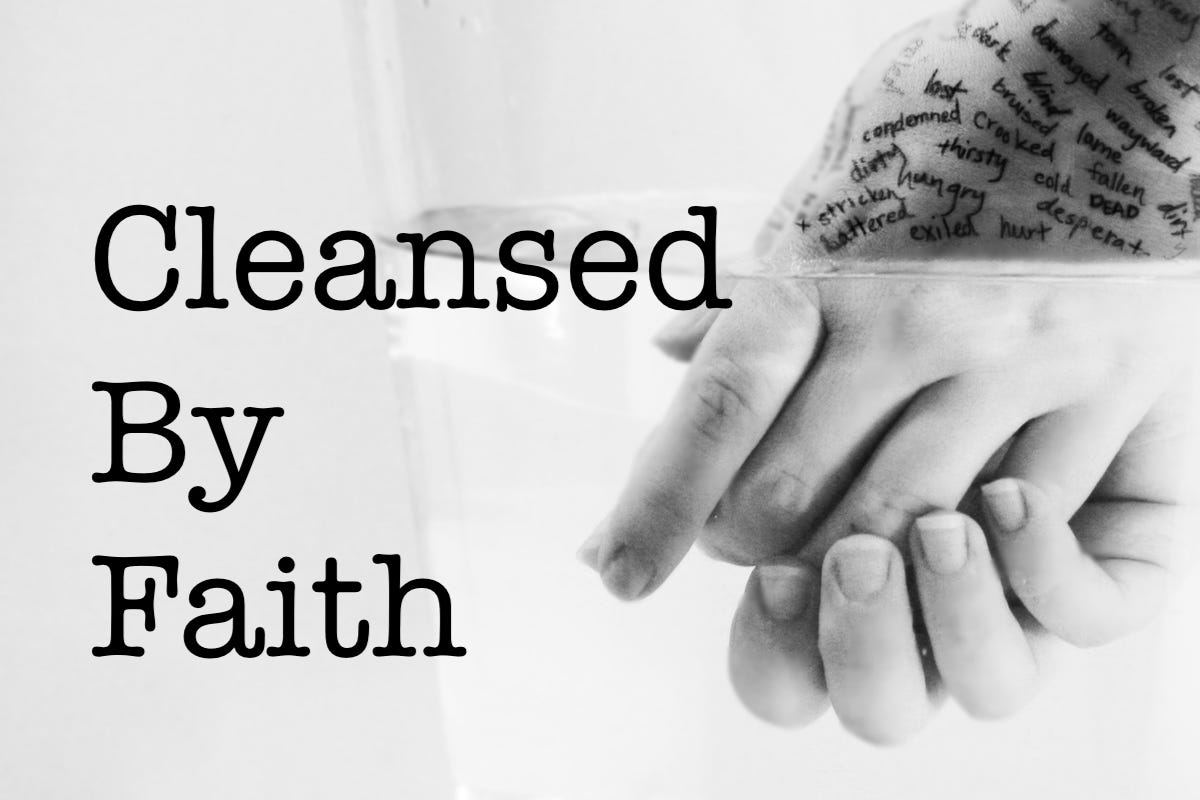
Cleansed By Faith
What if the people you have quietly written off are exactly where the Holy Spirit is most at work right now?

Christ is risen!
It’s so easy to be “one-sided!”
You know what I mean. “That idea is so wrong, and everyone who thinks that way and acts that way is misguided.” And you may be right about that, BUT there is also a danger on the other side.
You can become just as misguided by insisting you’re right as those who are stumbling on the other side.
It’s easy to fall into this trap. In fact, it is one of the most common stumbles we humans face. We end up trying to do the right thing for all the wrong reasons.
“He made no distinction between us and them, but cleansed their hearts by faith.”
That pattern of thinking and doing is as destructive to your spiritual life as outright lawlessness. Because it is also a form of lawlessness.
It puts me beyond the heart-softening disciplines of humility and repentance, and it turns those who disagree with me into “enemies.” We have to be attentive enough to our own weaknesses that we avoid falling into what the Fathers called prelest, or self-righteousness. When we reduce our love for God to mere rule-keeping, we risk forgetting God altogether and focusing only on “following the rules.”
This is why we are called to be in communion with each other. This is why we have to regularly practice the spiritual discipline of confession, so we never forget our own desperate need for grace and mercy. When we forget that, we stop offering grace and mercy to others.
Today is Friday of the Fifth Week after Pascha. We continue our journey through Acts and the great controversy that opened the Faith to the entire world.
Today’s Lesson: Acts 15:5-12
In those days, some believers who belonged to the party of the Pharisees rose up, and said, “It is necessary to circumcise them, and to charge them to keep the law of Moses.” The apostles and the elders were gathered together to consider this matter. And after there had been much debate, Peter rose and said to them, “Brethren, you know that in the early days God made choice among you, that by my mouth the Gentiles should hear the word of the gospel and believe. And God who knows the heart bore witness to them, giving them the Holy Spirit just as he did to us; and he made no distinction between us and them, but cleansed their hearts by faith. Now therefore why do you make trial of God by putting a yoke upon the neck of the disciples which neither our fathers nor we have been able to bear? But we believe that we shall be saved through the grace of the Lord Jesus, just as they will.” And all the assembly kept silence; and they listened to Barnabas and Paul as they related what signs and wonders God had done through them among the Gentiles.
This is the first real crisis in the newly formed Church, and it is a big one.
The moment we are reading about today is the tipping point that transfigures the early Church from just one more group of Jews who differ in theology to a Church that will spread through the whole world.
And it all has to do with identity.
Is Jesus a Jewish Messiah whose followers must keep the Jewish Law? Or is He the Savior of the entire world, calling people from every nation through faith?
What Can We Take From This?
First, the Holy Spirit makes no distinction between people we instinctively divide.
Notice St. Peter’s central claim. “God who knows the heart bore witness to them, giving them the Holy Spirit just as he did to us; and he made no distinction between us and them, but cleansed their hearts by faith.”
This is staggering when you sit with it. Peter says that God Himself does not see the categories humans use to divide one another. He sees hearts. And the Holy Spirit moves where He wills, cleansing hearts by faith regardless of the boxes we put people in.
This is one of the most countercultural truths of the Faith.
Our age is obsessed with categories. Political tribes. Cultural identities. Generational divides. Theological camps. We sort everyone into “us” and “them” almost without noticing.
But the Risen Lord refuses to honor those categories. He pours out His Spirit on the people we would not have chosen. He cleanses hearts that we had already written off. He works in lives we had already labeled hopeless.
When the family member you’ve privately given up on shows signs of softening. When the coworker whose politics infuriate you displays an unexpected kindness. When the parishioner you find difficult speaks a word that touches your heart. When you encounter genuine faith in someone whose tradition or background you had assumed was inferior.
In each of these moments, the Lord is reminding you that He makes no distinction. The question is whether you will catch up with what He is already doing.
Next, we cannot demand of others what we ourselves have failed to keep.
Peter’s question to the Pharisees is devastating in its honesty. “Why do you make trial of God by putting a yoke upon the neck of the disciples which neither our fathers nor we have been able to bear?”
He is naming the great hypocrisy of religious self-righteousness. The very Law that the Pharisees wanted to impose on the Gentiles was the Law that no Jew had ever kept perfectly. They had failed at it for centuries. And now they wanted Gentile converts to carry the same yoke.
This is one of the most insidious patterns in religious life. We hold others to standards we ourselves have not met. We expect spiritual maturity in others that we have not yet attained. We demand that family members exhibit behaviors we are unwilling to model. We criticize in others the very things we excuse in ourselves.
The discipline of confession is the antidote to this pattern. When we regularly stand before God and a spiritual father and name our own sins honestly, we lose the appetite for naming everyone else’s sins. When we have just received mercy, we are far more likely to extend mercy. When we have just confessed our own desperate need for grace, we cannot stand in judgment over someone else’s need for the same.
The rules are good. They reveal to us how much we need God’s mercy. But the moment we start using the rules to club others rather than to humble ourselves, we have stepped into the very pattern Peter rebuked.
Finally, the Church grows when the assembly listens.
Look at what happens after Peter speaks. “All the assembly kept silence; and they listened to Barnabas and Paul as they related what signs and wonders God had done through them among the Gentiles.”
The assembly kept silent. They listened.
This is the wisdom that finally resolved the controversy. Not louder arguments. Not more aggressive insistence. The willingness of the whole community to fall silent and listen to what the Lord had actually been doing.
When the Faithful gather and genuinely listen, the Holy Spirit can guide. When everyone is talking, and no one is hearing, controversy hardens into division. The early Church had its first great Council not because they shouted each other down, but because they were willing to be silent together.
This was good. The controversy was good. It wasn’t comfortable, but it was good. St. Paul became the Apostle to the Gentiles precisely because the Church was willing to wrestle with this question rather than ignore it. And the entire world has been blessed because they did.
St. Pachomius the Great
Today we commemorate St. Pachomius the Great, one of the most consequential figures in the history of Christian monasticism. Born in Egypt around 292 AD, he was raised pagan and conscripted into the Roman army as a young man. While serving, he encountered Christian believers whose kindness toward suffering soldiers astonished him. After his release from the army, he sought baptism and became a Christian.
After years of living as a hermit under the guidance of an elder, Pachomius received a vision calling him to gather monks into communities. This was a new development. Until then, most monks had lived as solitaries in the desert. Pachomius established the first cenobitic monasteries, where monks lived together under a common rule, sharing meals, prayer, and labor. By his death around 348 AD, his monastic federation included thousands of monks across multiple monasteries in Egypt.
St. Pachomius understood what Peter understood. The Holy Spirit makes no distinction between hermits and community-dwellers, between desert mystics and ordinary brothers laboring side by side. He saw that genuine spiritual growth could happen in community life with the same depth as in solitude. He gave the Church a pattern that has shaped Orthodox monasticism for seventeen centuries.
His witness teaches us what today’s reading teaches us. The Holy Spirit cleanses hearts by faith, not by external categories. And the people who flourish in the Christian life are those who are willing to be formed alongside others, listening together, struggling together, and growing together into the likeness of Christ.
Your Response Today
Here is one practice for today. When you find yourself dividing people into “us” and “them,” whether in your thoughts, in conversation, or in your reaction to something you read, pause and ask yourself this honest question:
“Where am I demanding of others what I have not yet kept myself?”
Then pray simply:
“Lord Jesus Christ, You make no distinction. Cleanse my heart by faith, and let me see others through Your eyes rather than through my categories.”
The Risen Lord is at work in places we do not expect and through people we would not have chosen. Our task is to keep our own hearts soft enough to recognize what He is doing.
Being Orthodox on Purpose means receiving daily mercy from the Lord and refusing to demand of others what we ourselves have not yet kept!
A note from Fr. Barnabas: This devotional uses our refined format. If you find these changes helpful, or if you have suggestions, please let me know. Your feedback shapes this ministry.
May the Risen Lord cleanse your heart by faith today and free you from every category that keeps you from seeing your brother and sister as He sees them.
P.S. Holy Father Pachomius the Great, you saw that the Holy Spirit could form holy lives in community as surely as in solitude, and you gave the Church a pattern of common life that has shaped souls for seventeen centuries. Intercede with Christ our God that our souls may be saved.
Our New Video Project still needs your help.
“The Journey Continues…” Project: creating a teaching series on how to practice your Faith after you convert to Orthodoxy. Topics will include going to confession, wise fasting practices, setting up your prayer corner at home, and more!
Would you consider a Special Gift to Faith Encouraged for this Project?
Every gift is doubled up to $25,000
Your Tax-deductible gift can be made here - https://www.paypal.com/ncp/payment/QFKQ4GL6MQBBQ

Fr. Barnabas Powell is the parish priest at Sts. Raphael, Nicholas, and Irene Greek Orthodox Church in Cumming, GA. He is also the founder of Faith Encouraged Ministries and produces the Faith Encouraged Daily Devotional on Substack. Watch the Faith Encouraged YouTube Channel here - https://www.youtube.com/@FaithEncouragedTV

Thank you for this message. I strive to see myself as a main sin and in need of salvation and wish not hell even to the worst of my enemies as they need Grace and Love as well.