

Cracked Pots
Imagine the unbelievable love of God, putting His greatest treasure in clay pots like us. Even cracked pots become vessels of glory because of Christ's love.

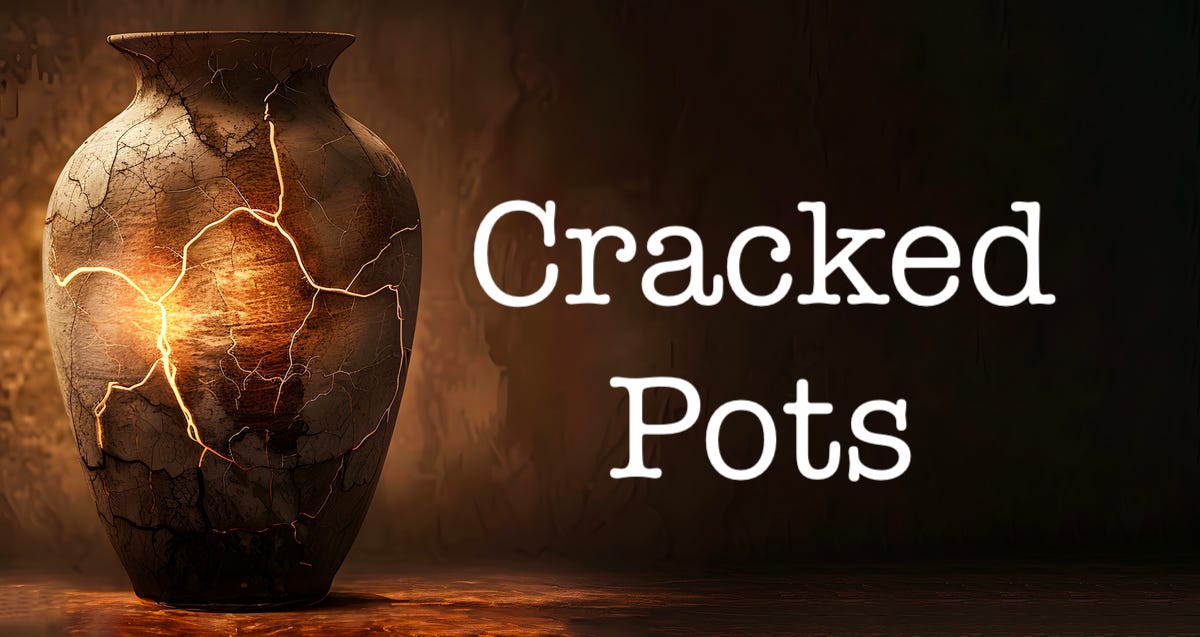
I was helping one of my daughters make a pot out of molding clay. We were waiting for the clay to harden in the kiln, and when she took it out, she dropped it and it broke into pieces.
She looked devastated. “Dad, I ruined it. All that work”
I picked up the pieces, and we used some strong glue to put it back together. It wasn’t perfect, but it was unique, and it was our work and memory together.
I said, “It’s beautiful.”
She looked confused. “But it’s broken.”
“Exactly. And sometimes God uses broken things to show His love in ways whole things never could.”
That’s what St. Paul is teaching in today’s passage. We are the broken vessels. The cracked pots. The fragile containers.
And God brings out His beauty in cracked pots!
Today’s Lesson: 2 Corinthians 4:6-15
Brethren, it is the God who said, “Let light shine out of darkness,” who has shone in our hearts to give the light of the knowledge of the glory of God in the face of Christ. But we have this treasure in earthen vessels, to show that the transcendent power belongs to God and not to us. We are afflicted in every way, but not crushed; perplexed, but not driven to despair; persecuted, but not forsaken; struck down, but not destroyed; always carrying in the body the death of Jesus, so that the life of Jesus may also be manifested in our bodies. For while we live we are always being given up to death for Jesus’ sake, so that the life of Jesus may be manifested in our mortal flesh. So death is at work in us, but life in you. Since we have the same spirit of faith as he had who wrote, “I believed, and so I spoke,” we too believe, and so we speak, knowing that he who raised the Lord Jesus will raise us also with Jesus and bring us with you into his presence. For it is all for your sake, so that as grace extends to more and more people it may increase thanksgiving, to the glory of God.
St. Paul uses a brilliant metaphor.
“We have this treasure in earthen vessels.”
Earthen vessels. Clay pots. Fragile, easily broken containers.
In Paul’s day, valuable things—gold, jewels, important documents—were stored in expensive containers. Bronze. Silver. Marble.
But God chose to put His treasure—the light of the knowledge of His glory—in clay pots. Fragile human beings. Broken people.
Why?
“To show that the transcendent power belongs to God and not to us.”
If you put gold in a gold container, people might admire the container. But if you put gold in a cracked clay pot, everyone knows the value is in what’s inside, not the container holding it.
God uses broken vessels, so everyone can marvel that the clay pot has been made precious by the content of God’s grace.
What Can We Take From This?
First, your weakness is not a disqualification—it’s the qualification.
“We have this treasure in earthen vessels.”
We want to be strong, impressive, capable vessels. We want to prove we’re worthy to carry God’s treasure.
But that’s precisely backwards.
God doesn’t use us despite our weakness. He uses us because of our weakness. Our fragility is the point. It makes His grace all the more beautiful.
“We are afflicted in every way, but not crushed; perplexed, but not driven to despair; persecuted, but not forsaken; struck down, but not destroyed.”
Notice Paul doesn’t say, “We’re never afflicted.” He says we ARE afflicted—but not crushed. We ARE perplexed—but not despairing. We ARE persecuted—but not forsaken. We ARE struck down—but not destroyed.
The Orthodox Christian life isn’t about avoiding suffering. It’s about suffering in a way that reveals God’s power to sustain us. And God’s amazing grace in valuing clay pots that are transfigured into bearers of His grace!
When you’re afflicted but not crushed, people see something supernatural. When you’re perplexed but not despairing, people see hope that doesn’t come from circumstances. When you’re persecuted but not forsaken, people see God’s presence.
Your weakness becomes the stage for God’s strength. And His proclamation of your value to Him!
Stop trying to appear strong. Stop hiding your struggles. Stop pretending you have it all together.
You’re a clay pot. Embrace it. Because that’s exactly what God uses to display His glory.
Next, death at work in you produces life in others.
“We are always being given up to death for Jesus’ sake, so that the life of Jesus may be manifested in our mortal flesh. So death is at work in us, but life in you.”
This is profound and often overlooked.
The Christian life requires you to die—to your ego, your comfort, your preferences, your rights, your dreams. Daily. Constantly. “Always being given up to death.”
But here’s the mystery: Your death produces life in others. And in your own soul.
When you die to yourself to serve your family, they receive life. When you sacrifice your comfort to help a neighbor, they receive life. When you give up your preferences to love your enemy, they receive life.
Death is at work in you. Life is at work in them.
This is the pattern of the Cross. Jesus died so we could live. And now we die so others can live.
If you’re not dying to yourself in some way, you’re not giving life to anyone. If your Christianity costs you nothing, it’s giving others nothing.
The light shines through the cracks. And the cracks come from being broken, from being given up to death, from being poured out for others.
Finally, suffering is worth it because resurrection is certain.
“We know that he who raised the Lord Jesus will raise us also with Jesus.”
Paul can endure affliction, perplexity, persecution, being struck down—because he knows the end of the story.
Resurrection.
This isn’t just about dying and going to heaven someday. It’s about the power of resurrection life working in us now, even in the midst of death.
The same God who said “Let light shine out of darkness” at creation has shone in our hearts. The same God who raised Jesus from the dead will raise us.
So we can endure the breaking, the crushing, the afflicting—because we know it’s not the end. Death doesn’t have the final word. Resurrection does.
And in the meantime, our suffering isn’t pointless. It’s “all for your sake, so that as grace extends to more and more people it may increase thanksgiving, to the glory of God.”
Your suffering, when united to Christ, becomes a channel of grace to others. Your weakness becomes their strength. Your death becomes their life.
That’s worth it.
