

Loosing to Find
The Lord says the only way to find your life is by losing it!

It was a significant moment between my daughter and me.
We were at the mall and went into a store so she could buy some of the pins and stickers she loves.
Behind the counter was a young person with piercings on his nose, ears, and eyebrow. Half his hair was shaved, and the other half was purple. He was so very friendly, and we exchanged some small talk as we checked out.
Suddenly, a huge wave of compassion, pain, and sorrow swept over me to the point I began to weep.
We left, and my daughter was worried and asked if I was okay. Through sobs, I tried to explain that in a single moment, I had begun to feel such pain coming from this delightful young man who had been serving us. In an instant, I felt his fear, his loneliness, and his desperation to discover his identity and know himself. The feelings of anguish were too much, and I just sat on a bench in the mall with my daughter, trying to comfort me while I wept.
It was a surreal experience.
But it created a moment of discussion between us. How do we discover who we really are? How do we discover our true potential?
“Whoever would save his life will lose it, and whoever loses his life for my sake will find it.”
The young man behind that counter was doing what every human being does when they do not have a trustworthy answer to that question. He was trying to find himself by constructing himself, through appearance, through identity, through visible differentiation from the crowd. And the anguish I felt, coming from him, was that of a soul who has been working very hard on this project and not finding what he is looking for.
The Lord’s answer to that anguish is as counterintuitive as anything He ever said.
Stop trying to save your life. Lose it. And in losing it, find it.
Today’s Lesson: Matthew 16:24-28
The Lord said to his disciples, “If any man would come after me, let him deny himself and take up his cross and follow me. For whoever would save his life will lose it, and whoever loses his life for my sake will find it. For what will it profit a man, if he gains the whole world and forfeits his life? Or what shall a man give in return for his life? For the Son of man is to come with his angels in the glory of his Father and then he will repay every man for what he has done. Truly, I say to you, there are some standing here who will not taste death before they see the Son of man coming in his kingdom.”
The message of the Christian Faith is nothing less than the complete inversion of our world’s operating assumptions.
He who dies with the most toys wins. Look out for number one. It is a dog-eat-dog world.
Every one of these slogans is a lie that feeds our spiritual demise. And the Lord knows it. So He gives us the exact opposite.
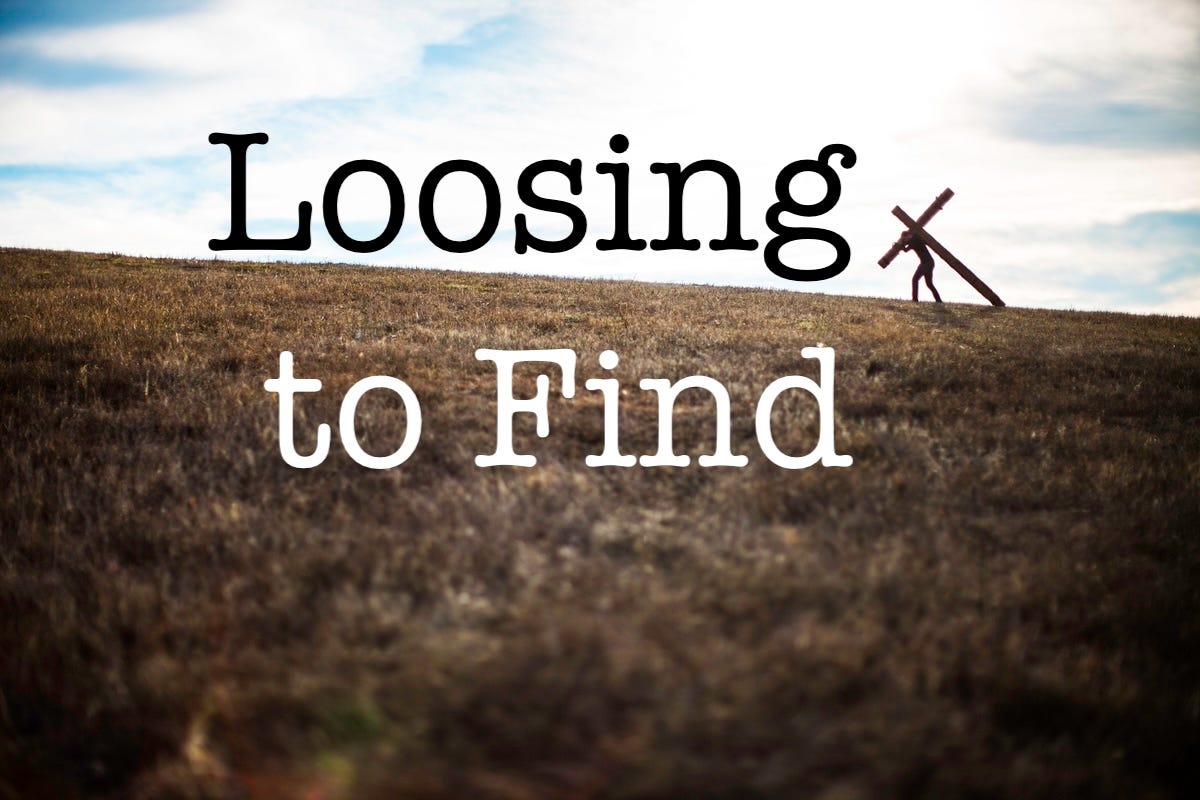
Deny yourself. Take up your cross. Follow Me.
What Can We Take From This?
First, the invitation to take up the cross is an invitation to let the Faith crucify the old, false self so your true self can emerge.
The cross the Lord is asking us to take up is not primarily about suffering. It is about death and resurrection. Specifically, the death of the false self and the resurrection of the true one.
Every person alive is carrying some version of the constructed self, the image I have built to protect myself from the world’s judgment, to manage other people’s perception of me, to convince myself and others that I am sufficient and secure. This false self is exhausting to maintain. It requires constant vigilance. And it will never find what it is actually looking for because it is looking in the wrong direction.
The young man in that store was not wrong to be searching for his identity. That hunger is real, and it is God-given.
What he has not yet been told is that the identity he is searching for cannot be constructed from the outside in. It can only be received from the One who made him and knows him completely.
“Take up your cross” means submitting my constructed self to the same death Christ died, so that what rises is not the self I made, but the self God intended.
This is what Orthodox life actually does in us when it is working as it should. The liturgical calendar, the fasting, the prayer, the Confession, the Eucharist, all of these are instruments of this ongoing crucifixion and resurrection. They are not additions to my life. They are the re-formation of it.
Next, we get what we truly need by passing through the door of its opposite.
“For whoever would save his life will lose it, and whoever loses his life for my sake will find it.”
This is a profound and practical truth. We get peace by passing through the discomfort of honest self-examination. We find our true identity by letting go of the false one. We discover our real potential by submitting it to the One who gave it to us in the first place.
This is both a comfort and a challenge.
A comfort when I am passing through a hard season, because the hardship itself, faithfully endured, is forming something in me that could not be formed any other way. And a challenge when my heart is painfully unaware of all the wisdom I am ignoring when I am not truly awake to what surrounds me.
Nothing is empty of this potential. No tear is wasted. No pain is purposeless. No difficult circumstance is unnecessary.
Every situation, by grace, holds the potential to make me more like Christ. The cross I carry is not an obstacle to my formation. It is the primary instrument of it.
The world’s version of this wisdom, “no pain, no gain,” is a pale shadow of what the Lord is actually describing. The world says suffering produces results. The Lord says suffering, offered to Him and carried faithfully, produces transformation into the One True Man, Christ Himself.
Finally, the entire Orthodox life is ordered to form this new orientation from the inside out.
The world forms us constantly, with or without our consent, through advertising, entertainment, social media, political messaging, and peer pressure, all conspiring to tell us who we are supposed to be and what we are supposed to want. This formation is relentless and largely invisible.
The Orthodox life is the counter-formation. Deliberate. Daily. Working from the inside out rather than the outside in.
The liturgical life of the Church gives us a rhythm that is not set by the world’s calendar but by the eternal calendar of God’s saving acts. The Divine Mysteries feed us with what no earthly nourishment can provide. The community of the parish, with all its friction and beauty and struggle, forms us in the virtues that can only be developed in relationship. The daily practice of the Faith, the morning and evening prayers, the fasting, the watchfulness, all of these are the instruments by which the old orientation is gradually replaced with the new.
This is the new normal that the Lord describes when He says, “Take up your cross and follow me.” Not a life of grim endurance, but a life of daily, oriented, purposeful formation toward the truest version of ourselves in communion with Him Who made us and knows us best.
“For what will it profit a man, if he gains the whole world and forfeits his life?”
The young man in that store is looking for his life. He just does not yet know where to find it. And perhaps the greatest thing we can do in this moment of the Orthodox Church’s growth in America is to be communities where people like him discover that what they have been searching for has a Name.
The Holy Prophet Ezekiel
Today, we commemorate the Holy Prophet St. Ezekiel, one of the four major prophets of the Old Testament, who prophesied during the Babylonian exile in the sixth century before Christ. Taken captive to Babylon along with much of Israel’s population, St. Ezekiel received extraordinary visions from God and proclaimed the word of the Lord to a people living in the confusion and grief of national catastrophe.
His most famous vision, the valley of dry bones that came to life at the breath of God, is one of the most powerful images of resurrection and renewal in all of Scripture. He also saw the vision of the divine chariot, the merkabah, and a vision of a closed gate through which only God could pass, which the Fathers interpreted as a prophecy of the Theotokos and the Incarnation.
St. Ezekiel understood the Lord’s paradox from the inside. He proclaimed the word of God to a people who had lost everything, and in that losing everything, they were being prepared to find something they had never fully possessed, even when they had all their earthly security around them. He is the prophet of resurrection to people who thought their story was over.
Your Response Today
Today, look honestly at whatever you are carrying.
Not with resignation, and not with the false cheerfulness of someone pretending the cross is not heavy. But with the genuine faith that this particular cross, in this particular season, held faithfully and offered to Christ, is packed with the potential to form in you something that could not be formed any other way.
And if you find yourself, like that young man in the store, still searching for your identity from the outside in, bring that search to the Lord Who already knows exactly who you are and what you are capable of becoming.
Then pray simply:
“Lord Jesus Christ, I take up my cross today. Not because I have the strength to carry it, but because You have promised that in losing my life for Your sake, I will find it. Form me from the inside out into the truest version of myself, the one You have always known, the one only You can make real.”
Being Orthodox on Purpose means submitting my constructed false self to the daily crucifixion of the Orthodox life, trusting that what rises from that death is my truest self, formed in the image and growing toward the likeness of Christ!
P.S. O divine Ezekiel, as God’s true Prophet, you foretold unto all the Incarnation of the Lord, the Lamb of God, the Artificer, the Son of God, the Eternal made manifest.
A Special Message from Fr. Barnabas:
I want to say “thank you” to all of you who help make this daily devotional ministry possible - my paid subscribers. Your support really does help me keep going after all these years. We started this devotional ministry in 2012 because I wanted to make sure my local parish family was being formed by the tremendous wisdom in our daily readings from the Archdiocese.
And now, all these years later, we are still going strong - thanks to God’s grace and your faithful support!
To those who are free subscribers, I am grateful as well. Our subscriptions, whether free or paid, have pushed Faith Encouraged as one of the most consistently used devotional tools on Substack! We regularly appear on the “best sellers” list for religious writings.
Would you consider becoming a paid subscriber to help us support this work? Please click the Subscribe button and join our support team!
Thanks
Fr. Barnabas Powell is the parish priest at Sts. Raphael, Nicholas, and Irene Greek Orthodox Church in Cumming, GA. He is also the founder of Faith Encouraged Ministries and produces the Faith Encouraged Daily Devotional on Substack. Watch the Faith Encouraged YouTube Channel here - https://www.youtube.com/@FaithEncouragedTV
