

No Small Debate
What if the very disagreements you keep trying to avoid are the place the Holy Spirit most wants to do His work in your life?

Christ is risen!
Our age has confused noise with conversation. We have countless platforms, endless commentary, and constant exchange of opinions. And yet the lost art of true dialogos (real, honest, humble dialogue between people who actually want to understand one another) seems harder to find than ever.
We are quick to label and dismiss. We are slow to listen and learn. We retreat into tribes that confirm what we already believe, then call our agreement with one another “community.” But community is something far deeper and far more challenging than mere “agreement.”
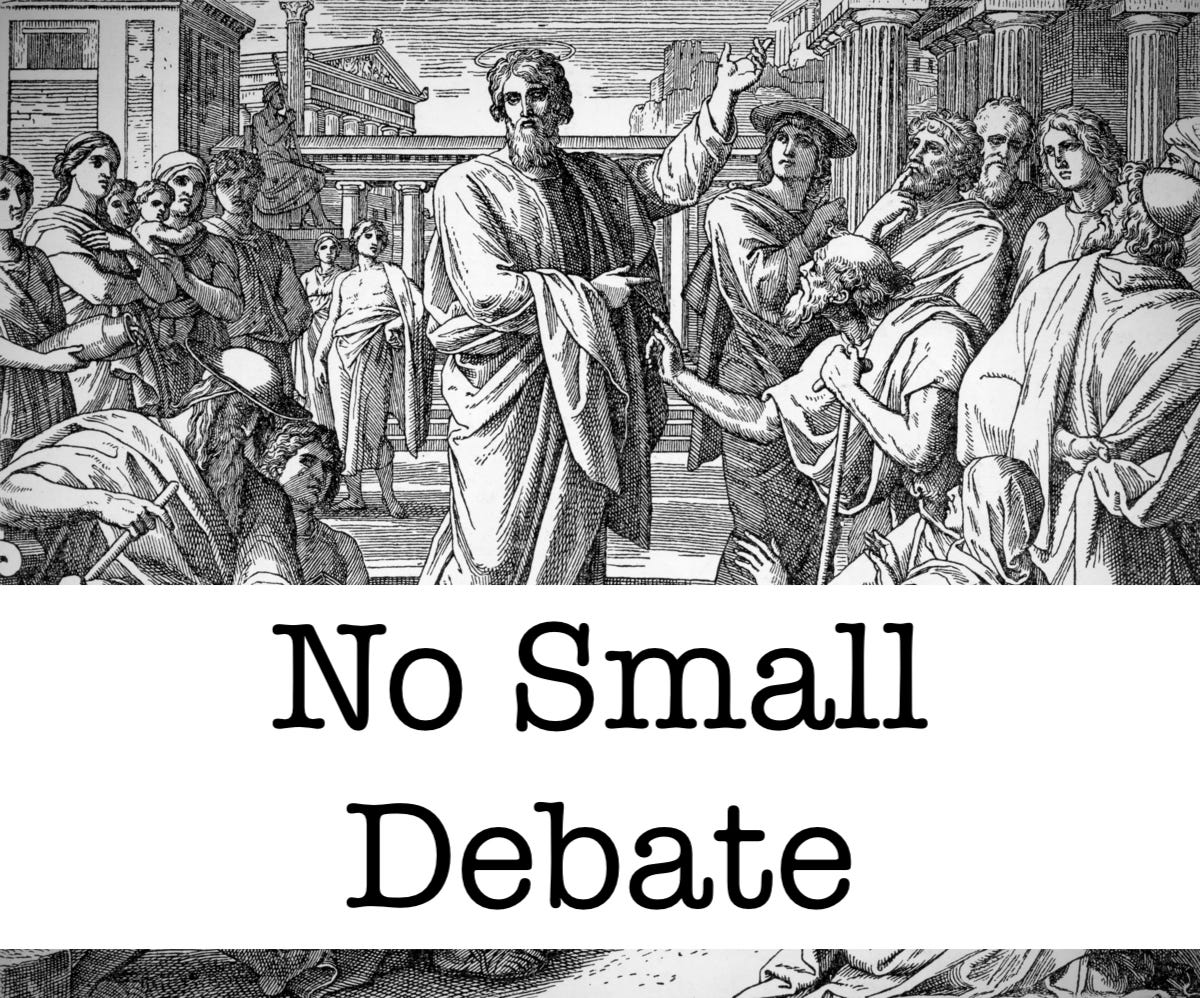
“Paul and Barnabas had no small dissension and debate with them.”
The Resurrection has not given us a faith that avoids difficult conversations. It has given us a faith that knows how to have them. The early Church did not split over the question of Gentile inclusion. They gathered. They dialogued. They listened. They prayed. And the Holy Spirit led them to a unity richer than the easy agreement they could have manufactured by keeping silent.
Today is Thursday of the Fifth Week after Pascha. We continue to witness the consequences of the Resurrection in the readings from Acts. Today, we see the explosive growth of the Gentile mission and the Church's very first major controversy.
Today’s Lesson: Acts 14:20-28; 15:1-4
In those days, Paul went on with Barnabas to Derbe. When they had preached the gospel to that city and had made many disciples, they returned to Lystra and to Iconion and to Antioch, strengthening the souls of the disciples, exhorting them to continue in the faith, and saying that through many tribulations we must enter the kingdom of God. And when they had appointed elders for them in every church, with prayer and fasting they committed them to the Lord in whom they believed. Then they passed through Pisidia, and came to Pamphylia. And when they had spoken the word in Perga, they went down to Attalia; and from there they sailed to Antioch, where they had been commended to the grace of God for the work which they had fulfilled. And when they arrived, they gathered the church together and declared all that God had done with them, and how he had opened a door of faith to the Gentiles. And they remained no little time with the disciples. But some men came down from Judea and were teaching the brethren, “Unless you are circumcised according to the custom of Moses, you cannot be saved.” And when Paul and Barnabas had no small dissension and debate with them, Paul and Barnabas and some of the others were appointed to go up to Jerusalem to the apostles and the elders about this question. So, being sent on their way by the church, they passed through both Phoenicia and Samaria, reporting the conversion of the Gentiles, and they gave great joy to all the brethren. And when they came to Jerusalem, they were welcomed by the church and the apostles and the elders, and they declared all that God had done with them.
The Apostles Paul and Barnabas have been racking up Gentile converts at a remarkable pace.
The Holy Spirit is opening a door of faith that the Jewish believers had not anticipated. Kinda like all the new converts to Orthodoxy today.
And immediately, this success creates a controversy. Some Jewish Christians from Judea began teaching that Gentile converts must first become Jewish, including circumcision, before they can become Christian. Paul and Barnabas disagree. The text tells us there was “no small dissension and debate.” And what happens next reveals the genius of the Church led by the Spirit.
What Can We Take From This?
First, salvation always happens in community, never in isolation.
Notice what Paul and Barnabas do throughout this passage. They preach the Gospel and make disciples. Then they appoint elders in every church. Then they return to Antioch and gather the whole church together to report. When the controversy arises, they don’t strike out on their own to solve it. They go up to Jerusalem to consult with the Apostles and elders.
This is not a faith of isolated individuals figuring things out alone. This is a Body, a community, a spiritual family that bears one another’s burdens and works through challenges together.
Our age tells us that faith is private. That spirituality is what we do alone. That we don’t need other people to interpret Scripture for us or to walk with us in our discipleship.
The early Church demonstrates the opposite. The Faith is communal because we are saved into a Body, not into isolated spiritual experiences. Christ did not establish individual contracts with each believer. He established a Church. And it is in the messy, sometimes difficult life of that Church that we are formed and saved.
The marathon of faithfulness is not run solo. It is run together, with all the joys and frictions that real community always involves.
Next, healthy controversy can produce holier outcomes than easy agreement.
Look at what the controversy in today’s passage actually accomplishes. The argument over Gentile inclusion does not split the Church. It drives the Church to its first great Council in Jerusalem. There the Apostles gather, listen to each other, pray together, and discern what “seemed good to the Holy Spirit, and to us.”
The fruit of this controversy is staggering. The conversion of the Roman Empire. The permanent transformation of human civilization. None of that would have happened if the Church had either suppressed the disagreement or split over it.
Most of us instinctively flee conflict. We confuse peace with the absence of disagreement, when biblical peace is something far richer. The Church does not pretend conflict isn’t there. The Church faces conflict in love and lets the Holy Spirit do something through it that easy agreement could never have accomplished.
When tension surfaces in your parish council. When the difficult conversation looms with a family member. When the Church speaks on a matter you find challenging. When a brother or sister offers a perspective you would rather not hear.
These moments are invitations, not obstacles. The Holy Spirit often speaks most clearly through the very disagreements we wish we could avoid. Sit with the discomfort. Listen carefully. Pray honestly. The Risen Lord may be doing something through the friction that you could not have produced any other way.
Finally, real dialogue requires both the willingness to listen and the courage to stand on what cannot be moved.
There is a beautiful balance in today’s reading. Paul and Barnabas listen. They go up to Jerusalem rather than dismissing the concerns of the Judean teachers. They take the question seriously enough to convene the entire Apostolic Council.
But they also stand firm on what cannot be moved. The Gentiles are saved through faith in the Risen Christ. The Holy Spirit has confirmed this through the conversions and the witness of God’s grace. They are willing to discuss everything that can be discussed, but they will not surrender the central truth of the Gospel.
This is the wisdom we need today. We must always be willing to talk. We must always be willing to listen. We must always be willing to consider whether the Holy Spirit is saying something through a perspective we initially resisted.
But there is also a place where dialogue must come to an honest end. There are foundations that the Church cannot move because they are not ours to move. The Resurrection is not negotiable. The Person of Christ is not negotiable. The teachings handed down from the Apostles are not ours to revise.
The mature Orthodox Christian holds both truths together. Always ready to converse. Never willing to compromise the unchanging Faith.
St. Isidore the Martyr of Chios
Today we commemorate St. Isidore the Martyr of Chios. He was a Roman soldier in the third century, serving in the imperial army during the reign of Emperor Decius. Stationed on the island of Chios, he was discovered to be a Christian when he refused to participate in the pagan sacrifices required of all soldiers.
Brought before his commanding officer, Numerian, Isidore was urged to renounce Christ. He refused. He was tortured cruelly, his tongue eventually cut out so he could not continue confessing his faith aloud. Yet tradition tells us that even without his tongue, he continued to glorify God audibly through the power of the Holy Spirit. He was finally beheaded for his witness around 250 AD.
St. Isidore’s tomb on Chios became a place of pilgrimage and many miracles. His body was later translated to Constantinople and then to Venice, where it remains to this day.
St. Isidore teaches us where dialogue ends, and witness begins. He could discuss many things. He could converse respectfully with his fellow soldiers. He could even endure their questions and pressure with patience. But when the demand to deny Christ came, the dialogue was over. The foundation could not be moved. He gave his life rather than compromise the unchanging Faith. His death became a witness more powerful than any conversation.
Your Response Today
Here is one practice for today. The next time you face a difficult disagreement, whether in your family, your parish, or in your own thoughts about a controversial issue, pause and ask:
“Am I refusing to listen to something the Holy Spirit might be saying? Or am I being asked to compromise something that cannot be moved?”
Both are real possibilities. The Risen Lord wants us to discern between them.
Then pray simply:
“Lord Jesus Christ, give me the humility to listen and the courage to stand. Lead me by Your Spirit into the unity that only You can create.”
We are not saved as isolated individuals. We are saved together. The marathon of faithfulness is run in community, with all its difficult conversations, unexpected friendships, and necessary debates.
Being Orthodox on Purpose means embracing the messy, life-giving work of being saved together with the people God has placed in your life, including the difficult conversations that lead us deeper into Christ!
A note from Fr. Barnabas: This devotional uses our refined format. If you find these changes helpful, or if you have suggestions, please let me know. Your feedback shapes this ministry.
May the Risen Lord give you the patience to listen well, the courage to stand firm, and the joy of being saved into His Body, the Church.
P.S. Holy Martyr Isidore of Chios, you witnessed to the Risen Christ even after your tongue was cut out, refusing to compromise the unchanging Faith and sealing your testimony with your blood. Intercede with Christ our God that our souls may be saved.
Please pray for Fr. Barnabas as he travels to Merriville, IN to speak at SS. Constantine & Helen Greek Orthodox Church for their May Parish Retreat!
Our New Video Project still needs your help.
“The Journey Continues…” Project: creating a teaching series on how to practice your Faith after you convert to Orthodoxy. Topics will include going to confession, wise fasting practices, setting up your prayer corner at home, and more!
Would you consider a Special Gift to Faith Encouraged for this Project?
Every gift is doubled up to $25,000
Your Tax-deductible gift can be made here - https://www.paypal.com/ncp/payment/QFKQ4GL6MQBBQ

Fr. Barnabas Powell is the parish priest at Sts. Raphael, Nicholas, and Irene Greek Orthodox Church in Cumming, GA. He is also the founder of Faith Encouraged Ministries and produces the Faith Encouraged Daily Devotional on Substack. Watch the Faith Encouraged YouTube Channel here - https://www.youtube.com/@FaithEncouragedTV
