

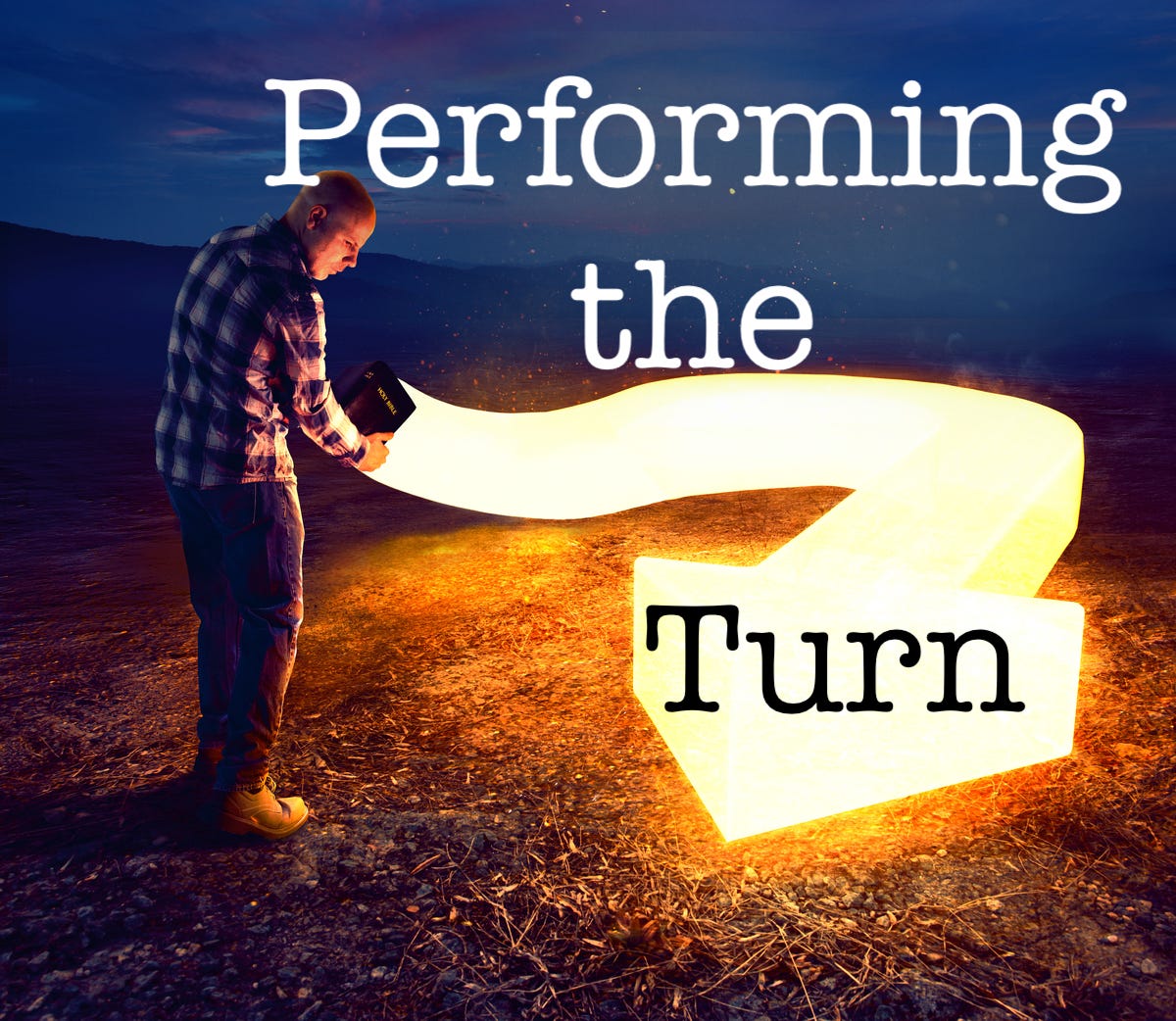
Performing the Turn
What if the repentance you have been treating as an emergency brake is actually meant to be the steering wheel?

Christ is ascended!
For most of my early years as a Christian, I treated repentance like an emergency brake. You only pulled it when things got really bad. You yanked it hard at a revival meeting, at a low point, after a moral failure, after a funeral that scared you. You felt the lurch, you cried a little, you made some promises, and then you released the brake and went right back to driving the same way you had been driving.
That is not Orthodox repentance. That was never Orthodox repentance. And the longer I serve as a priest, the more I see how many of our Faithful still operate with that emergency-brake idea of “metanoia” rather than the lifelong reorientation the Fathers describe.
“This life has been given to you for repentance. Do not waste it in vain pursuits.” St. Isaac the Syrian
When St. Paul stands before King Agrippa and gives testimony to his entire life, he does not say he was sent to preach so that people should feel sorry. He says he was sent to preach that they should repent, turn, and perform. Three movements that are really one motion. And that motion is the shape of the whole Christian life.
Today is the Feast of the Ascension of our Lord, God, and Savior Jesus Christ. Forty days after Pascha, the Risen Christ lifts our humanity into the very life of the Holy Trinity. He does not abandon us. He goes to prepare a place for us, and He sends His Holy Spirit to dwell in us. The Church now enters the ten-day vigil between Ascension and Pentecost, watching and praying with the Apostles. Christ is ascended, and our human nature has been seated at the right hand of the Father!
Today’s Lesson: Acts 26:1, 12-20
In those days, King Agrippa said to Paul, “You have permission to speak for yourself.” Then Paul stretched out his hand and made his defense: “I journeyed to Damascus with the authority and commission of the chief priests. At midday, O king, I saw on the way a light from heaven, brighter than the sun, shining round me and those who journeyed with me. And when we had all fallen to the ground, I heard a voice saying to me in the Hebrew language, ‘Saul, Saul, why do you persecute me? It hurts you to kick against the goads.’ And I said, ‘Who are you, Lord?’ And the Lord said, ‘I am Jesus whom you are persecuting. But rise and stand upon your feet; for I have appeared to you for this purpose, to appoint you to serve and bear witness to the things in which you have seen me and to those in which I will appear to you, delivering you from the people and from the Gentiles, to whom I send you to open their eyes, that they may turn from darkness to light and from the power of Satan to God, that they may receive forgiveness of sins and a place among those who are sanctified by faith in me.’ Wherefore, O King Agrippa, I was not disobedient to the heavenly vision, but declared first to those at Damascus, then at Jerusalem and throughout all the country of Judea, and also to the Gentiles, that they should repent and turn to God and perform deeds worthy of their repentance.”
We visited this passage two weeks ago and focused on Paul’s heavenly vision. Today, the Church places this reading before us again on the Feast of the Ascension, and a different word in it demands our attention.
Notice that the Christ who appears to Saul on the road to Damascus is not a memory or a ghost or a symbol. He is the Ascended Christ, speaking from glory, calling a persecutor into a vocation that will shake the world. The Ascension is not a leaving. The Ascension is what makes the Damascus road encounter possible in the first place. And what does this Ascended Christ commission Saul to preach? Repentance. Turning. Deeds.
What Can We Take From This?
First, repentance is the reorientation of an entire life, not the emotion of a single moment.
In Orthodoxy, we see repentance as the constant, daily reorientation of our thoughts and actions toward God and eternal wisdom, rather than as slavery to the self-centered and undisciplined passions that create addictions, habits, and broken relationships that wreck us.
Read that again, because the modern religious air we all breathe has trained us to hear repentance as a feeling. It is not. Repentance is a direction. It is the slow, faithful, daily reorienting of the whole person, mind, body, and will, away from the passions that sicken us and toward the God who heals us.
A Seeker repents when he first turns his face toward Christ. A Catechumen repents as he learns what that turning will require. A member of the Faithful repents every single morning, every Confession, every Liturgy, every prayer of the heart, every refusal of an old pattern, every yes to a better one. The turning does not stop. It deepens.
Next, repentance produces deeds, or it was never repentance at all.
Look at the language St. Paul uses. “Perform deeds worthy of their repentance.” Worthy. Fitting. Matching.
The turning must show.
A man who claims to be turning toward God but keeps speaking to his wife as he always has is not turning. A woman who claims to be turning toward God but who keeps nursing the same resentment she has carried for twenty years is not turning. A young person who claims to be turning toward God but who keeps feeding the same digital appetite that is hollowing out their soul is not turning.
This is not legalism. This is honesty. Repentance behaves differently because repentance is real. Otherwise, it is sentiment dressed up in religious vocabulary.
St. Paul could stand before King Agrippa with such confidence because his own repentance had produced visible deeds. The man who once held the coats of those who stoned St. Stephen now stood in chains for the very name he had tried to destroy. His turning had cost him something. His turning had remade him. His turning was the proof that the Ascended Christ really had met him on that road.
Finally, this is the heart of the Normal Orthodox Life.
The whole point of the Normal Orthodox Life is to build a focused repentance lifestyle so that the reoriented life actually behaves differently from the life gripped by fear and self-deceit.
Fear says, “Protect yourself. Hoard. Retaliate. Hide.”
Self-deceit says, “You are fine. You do not need to change. The problem is everyone else.”
Repentance says, “Lord, have mercy. Show me. Heal me. Turn me.”
And then the deeds follow. Patience where there was anger. Generosity where there was greed. Honesty where there was pretending. Prayer where there was noise. Forgiveness where there was a grudge held so long it had grown roots in the soul. The turning becomes visible, and the visibility becomes witness, and the witness becomes the very thing the Ascended Christ sent St. Paul to preach to every nation.
The same Christ who lifted our humanity into the Trinity on this feast day is the same Christ who calls every Seeker, every Catechumen, every member of the Faithful to the slow daily work of turning.
The Feast of the Ascension
Today, the Church celebrates one of the great feasts of the year. Forty days after Pascha, on the Mount of Olives, the Risen Lord lifted His hands in blessing over His disciples and was taken up into heaven. The Apostles watched Him go. Two angels stood beside them and promised that this same Jesus would return in the same way they had seen Him depart.
The Ascension is not the absence of Christ. It is the lifting of our humanity into the glory of God. The flesh He took from the Theotokos, the flesh He carried to the Cross, the flesh that rose from the tomb on the third day, that very flesh now sits at the right hand of the Father. Where He is, our nature now is. Where He is, we are called to be.
The disciples returned from the Mount of Olives with great joy. Not because they had lost Him. Because they had finally understood where He was taking them.
Your Response Today
Today, on the Feast of the Ascension, pick one specific habit, one specific pattern, one specific corner of your life that you know is not yet turned toward God. Not all of them. One. Name it honestly before the Lord. Then choose one deed today that would be worthy of that turning. One conversation handled differently. One temptation refused. One prayer prayed when you would rather not. One small act of generosity. One honest word where there has been pretending.
That is repentance, my angels. Not the emotion. The turn. And then the deed that proves the turn was real.
And tomorrow, do it again. And the day after. Until the whole shape of your life has been quietly, faithfully, slowly remade by the Ascended Christ, Who is patient with His turning people.
Being Orthodox on Purpose means treating repentance as the daily shape of your life rather than the occasional emergency you reach for, and letting the turning produce the deeds that prove the Ascended Christ has truly remade you!
A note from Fr. Barnabas: This devotional uses our refined format. If you find these changes helpful, or if you have suggestions, please let me know. Your feedback shapes this ministry.
P.S. On this Feast of the Ascension, O Lord Jesus Christ, You ascended in glory and lifted our humanity into the very life of the Holy Trinity. Turn our hearts toward You today, and let our lives bear deeds worthy of the repentance to which You have called every nation. Christ is ascended!
Our New Video Project still needs your help.
“The Journey Continues…” Project: creating a teaching series on how to practice your Faith after you convert to Orthodoxy. Topics will include going to confession, wise fasting practices, setting up your prayer corner at home, and more!
Would you consider a Special Gift to Faith Encouraged for this Project?
Every gift is doubled up to $25,000
Your Tax-deductible gift can be made here - https://www.paypal.com/ncp/payment/QFKQ4GL6MQBBQ

Fr. Barnabas Powell is the parish priest at Sts. Raphael, Nicholas, and Irene Greek Orthodox Church in Cumming, GA. He is also the founder of Faith Encouraged Ministries and produces the Faith Encouraged Daily Devotional on Substack. Watch the Faith Encouraged YouTube Channel here - https://www.youtube.com/@FaithEncouragedTV

μετάνοια γίνομαι ❤️🩹
Christ is Ascended, from earth to heaven!
Holy Sovereigns Saints Constantine and Helen, pray for us!
Grace and peace to you Father! Great Joy...