

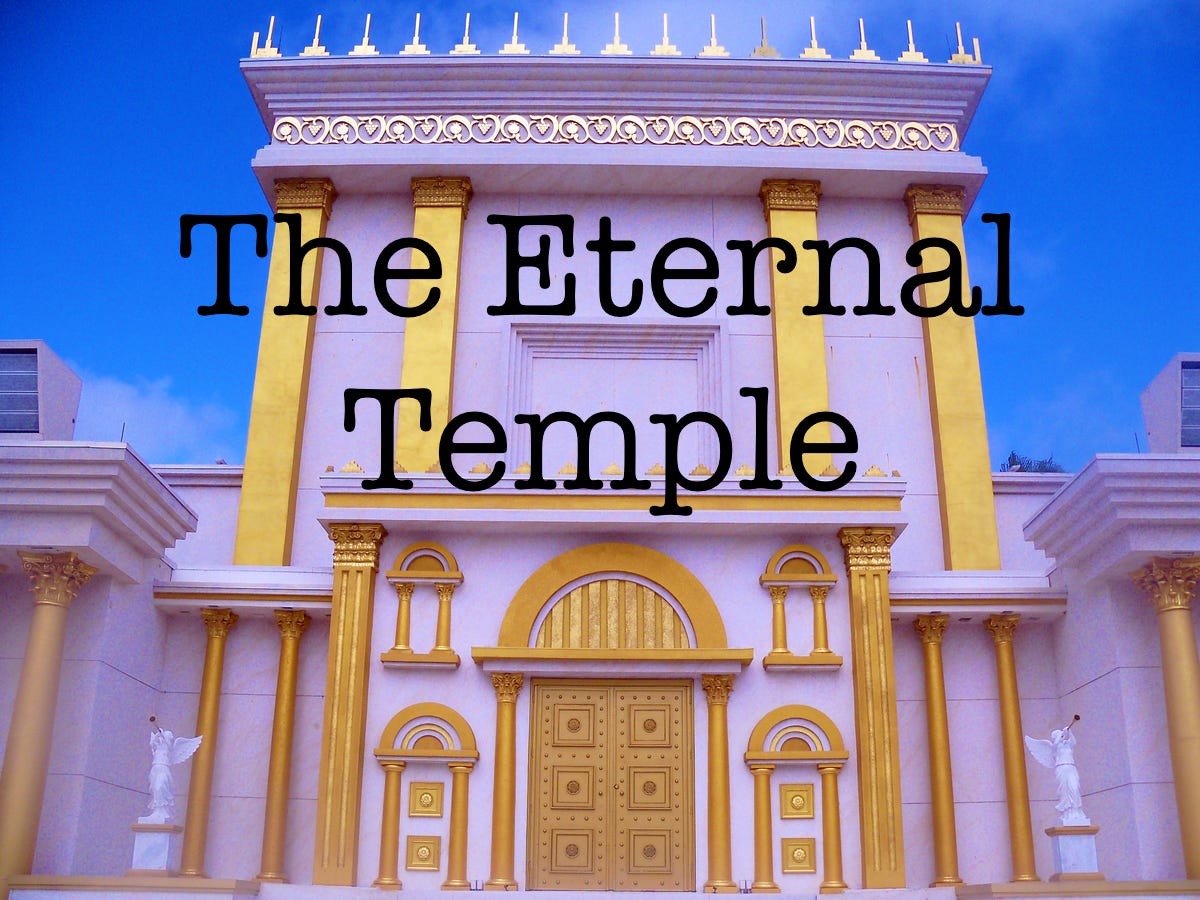
The Eternal Temple
The earthly sanctuary was never the destination. It was always the invitation to something eternal that Christ has now thrown open to everyone.

I remember reading Aesop’s Fables and Mother Goose stories to my kids when they were little, and they would actually sit still while I read to them! These stories contained cultural lessons passed down for generations. Humpty Dumpty. Old Mother Hubbard. The Hare and the Tortoise. The Boy Who Cried Wolf. They gave me a way to pass on wisdom in a form that has worked forever.
So imagine my surprise when I was talking to a group of eleven to fourteen-year-olds and mentioned David and Goliath, and many of them had no idea what I was talking about.
The diabolical theft of the wisdom of our Faith by those who wish to remake society into a secular desert can only happen if we refuse to preserve and champion the timeless truth that makes humans into civilized and whole persons.
God ain’t got no grandchildren. We have to prepare every generation to make this wisdom their own.
“These preparations having thus been made, the priests go continually into the outer tent, performing their ritual duties.”
This is why I want you handling the Scriptures every day. Familiarity with these stories equips you to apply their wisdom to your everyday life. And today’s lesson is quite significant as we discover the power of the Eternal Temple.
Today’s Lesson: Hebrews 9:1-7
Brethren, the first covenant had regulations for worship and an earthly sanctuary. For a tent was prepared, the outer one, in which were the lampstand and the table and the bread of the Presence; it is called the Holy Place. Behind the second curtain stood a tent called the Holy of Holies, having the golden altar of incense and the ark of the covenant covered on all sides with gold, which contained a golden urn holding the manna, and Aaron’s rod that budded, and the tables of the covenant; above it were the cherubim of glory overshadowing the mercy seat. Of these things we cannot now speak in detail. These preparations having thus been made, the priests go continually into the outer tent, performing their ritual duties; but into the second only the high priest goes, and he but once a year, and not without taking blood which he offers for himself and for the errors of the people.
St. Paul is writing to Hebrew Christians who are being tempted to abandon the Faith under the pressure of persecution and return to the old covenant. His argument is both pastoral and theological.
There is no going back.
Not because the old covenant was worthless, but because it was always pointing beyond itself. The Tabernacle Moses built in the wilderness was never meant to be the destination. It was always meant to be a shadow of something eternal.
What Can We Take From This?
First, the earthly sanctuary was always meant to be temporary, pointing us toward the eternal reality it could only shadow.
The very nature of the Tabernacle, a movable tent built for a wandering people, declared its own impermanence. And yet within it, everything was saturated with meaning.
The lampstand teaches the people that God is light.
The bread of the Presence teaches them that God feeds His people.
The ark containing the manna, Aaron’s rod, and the tablets of the covenant, each a memory of how God had sustained, led, and spoken to His people.
The regulations for worship, the rhythm of prayers, the shape of the liturgy, even how the priests were dressed, all were signposts pointing toward deeper and eternal meanings. The beauty was real. The symbols were true. But the Tabernacle itself was created to become obsolete, to yield to something greater.
Our materialistic age has lost this sense of the world as symbolic, as pointing beyond itself to ultimate reality. We have flattened creation into mere matter and, in doing so, have lost the ability to see the cosmic reality of Christ.
The re-enchantment our society desperately needs is not a new spirituality. It is the recovery of the ancient Christian vision that everything visible points toward the invisible, that every earthly beauty is a glimpse of the heavenly reality it images.
The Tabernacle was not the destination. It was the invitation.
Next, when we fixate on the outward forms without understanding why they exist, we lose both the forms and the reality they point toward.
All too often, we get enamored with the trappings and fixate on outward rule-keeping as if this were all there is. But that always produces a generation that does not know why the trappings are there. And the generation after that forgetful generation will not bother with the trappings at all.
This is exactly the danger Paul is addressing. These Hebrew Christians had received the forms, the Temple, the priesthood, the sacrifices, and the feast days. But under pressure, they were tempted to cling to the forms rather than to the reality the forms had always been pointing toward.
This is why we Orthodox must always focus on the why of our rituals and pass on this purposeful embrace to the next generation.
Catechizing our children and our Seekers is not optional.
It is the survival of the Faith in every generation.
If Orthodoxy becomes merely a cultural decoration, a Temporary Tent decorated with beautiful things, it will not survive. But if we look behind the beauty of the liturgy, the saints, the vestments, the candles, and the incense to the Eternal Temple they reveal, we give the next generation something worth dying for.
The forms matter. But they matter because of what they point toward, not in themselves.
Finally, Christ is creating in His Church the Eternal Temple that the earthly sanctuary could only shadow, and you are that Temple.
The high priest could enter the Holy of Holies only once a year, and not without the blood of a sacrifice.
One man.
Once a year.
Behind a curtain.
That was the closest the old covenant could bring humanity to God.
But look at what Jesus has done. He entered the true Holy of Holies, the very presence of the Father, with His own blood, once for all. And He threw the curtain open. The veil of the Temple tore from top to bottom at His death. The access that was once limited to one man once a year is now given to every believer every day.
And more than access. St. Paul tells us elsewhere that we ourselves have become the Temple. Not the buildings we build, but the lives transformed by the Eternal wisdom of the Faith once and for all delivered to the saints. The Church is the Eternal Temple, the permanent dwelling of the Holy Spirit in the world, the place where heaven and earth meet in every Liturgy.
You are that Temple. Your life, formed by prayer and fasting and the Eucharist and Confession, is the sacred vessel in which God makes His presence known to the world around you.
St. Juvenaly, Protomartyr of America and Alaska
Today, we commemorate St. Juvenaly of Alaska, the first Orthodox Christian martyr in the Americas. He was a hieromonk who arrived in Alaska with the first Orthodox mission in 1794, sent from Valaam Monastery in Russia to bring the Gospel to the indigenous peoples of the Aleutian Islands and Alaska.
St. Juvenaly traveled by kayak and on foot through some of the most inhospitable terrain on earth, baptizing thousands of indigenous people and bringing the Eternal Temple of the Church to a land that had never heard the Name of Jesus. He was martyred around 1796 near the Iliamna Lake region of Alaska, killed while on a missionary journey, becoming the first of many witnesses to the Faith in the New World.
His story is the living refutation of any notion that the Eternal Temple is limited by geography, ethnicity, or culture. The same Faith that filled the Tabernacle in the wilderness, that was perfected in Christ, that was handed down through the Apostles, was carried by a Russian monk in a kayak to the indigenous peoples of Alaska. And it transformed lives. And it built the Temple of God in human souls at the edge of the known world.
Your Response Today
Today, ask yourself honestly whether your faith is a Temporary Tent or an Eternal Temple.
Is it a cultural decoration, something you inherited without examining, a set of forms you observe without understanding why? Or have you looked behind the beauty of the liturgy and the candles and the vestments to the eternal reality they reveal?
If you have children or grandchildren in your life, ask yourself what you are passing on to them. Are they learning the stories? Do they know David and Goliath? Do they understand why we fast, why we pray, why we light candles, why we venerate icons? Without the why, the what will not survive the next generation.
Then pray simply:
“Lord Jesus Christ, You have made me a living stone in Your Eternal Temple. Let my life be a place where Your presence is real and recognizable. And give me the wisdom and the courage to pass on the why of this beautiful Faith to those coming after me.”
Being Orthodox on Purpose means living as the Eternal Temple God has made you to be, looking behind every outward form to the eternal reality it reveals, and passing that living wisdom on to every generation!
P.S. Holy Hieromartyr Juvenaly, you carried the Eternal Temple of the Orthodox Faith to the farthest edges of the earth, laying down your life so that the indigenous peoples of Alaska might know the living God. Intercede with Christ our God that our souls may be saved.
Please pray for Fr. Barnabas and family as we travel. We are thrilled our daughter is going to participate in the Summer Camp at Ionian Village. Here’s the website to learn more -
https://www.ionianvillage.org/
Here is a link where you can help Fr. Barnabas with our Video Project - Click HERE to Help!
Fr. Barnabas Powell is the parish priest at Sts. Raphael, Nicholas, and Irene Greek Orthodox Church in Cumming, GA. He is also the founder of Faith Encouraged Ministries and produces the Faith Encouraged Daily Devotional on Substack. Watch the Faith Encouraged YouTube Channel here - https://www.youtube.com/@FaithEncouragedTV

Most Holy Theotokos save us!