

"We Are Also Men"
What if the moments when others praise us are actually our most important opportunities to point past ourselves?

Christ is risen!
She started crying as I shook her hand. She was trembling, and I was both confused and troubled.
Her husband stepped in to save the day. “Father, she is very excited to meet you. We were going through a very difficult time when our family found your videos on YouTube. We watched your videos and then started receiving the daily devotionals, which touched us all so deeply. She’s very nervous and very grateful to you.”
What do you say to something like that? I confess I was very uncomfortable and quickly added that if they knew me as my wife and kids know me, they wouldn’t be excited to meet me at all!
“Men, why are you doing this? We also are men.”
It makes sense that people are grateful to God when God uses His creatures to minister to their needs. But this gratitude must always be tempered with sobriety. Jesus calls this Way of Life the “narrow” way. You have to pay attention if you’re going to get this right.
Today is Wednesday of the Fourth Week after Pascha. This day marks an important moment in the Paschal season: we are halfway to the Feast of Pentecost. As we continue our journey through Acts, we encounter a powerful warning about how easily even genuine miracles can be misunderstood by hearts formed in the wrong direction.
Today’s Lesson: Acts 14:6-18
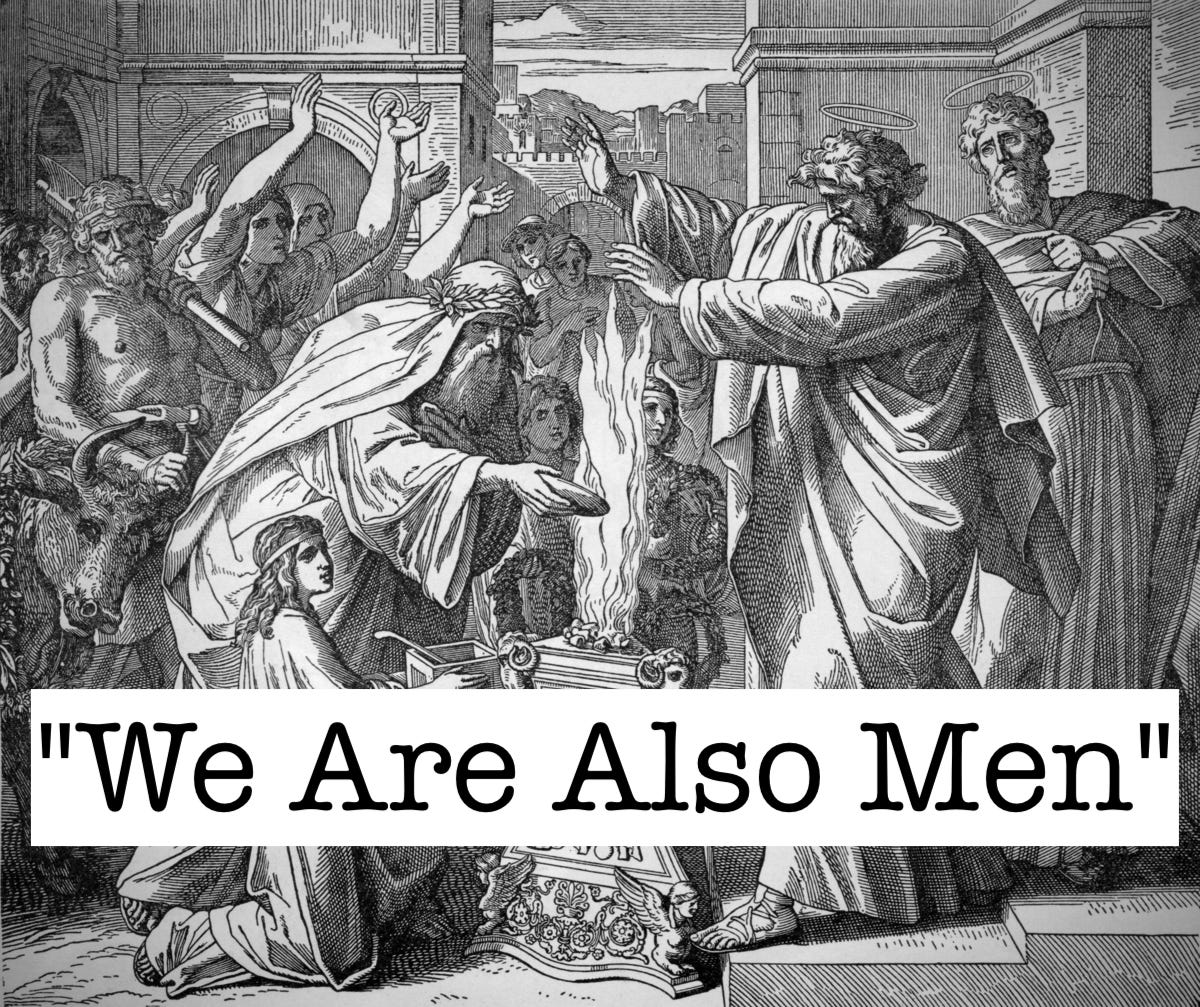
In those days, the apostles fled to Lystra and Derbe, cities of Lycaonia, and to the surrounding country; and there they preached the gospel. Now at Lystra there was a man sitting, who could not use his feet; he was a cripple from birth, who had never walked. He listened to Paul speaking; and Paul, looking intently at him and seeing that he had faith to be made well, said in a loud voice, “Stand upright on your feet.” And he sprang up and walked.
And when the crowds saw what Paul had done, they lifted up their voices, saying in Lycaonian, “The gods have come down to us in the likeness of men!” Barnabas they called Zeus, and Paul, because he was the chief speaker, they called Hermes. And the priest of Zeus, whose temple was in front of the city, brought oxen and garlands to the gates and wanted to offer sacrifice with the people.
But when the apostles Barnabas and Paul heard of it, they tore their garments and rushed out among the multitude, crying, “Men, why are you doing this? We also are men, of like nature with you, and bring you good news, that you should turn from these vain things to a living God who made the heaven and the earth and the sea and all that is in them. In past generations he allowed all the nations to walk in their own ways; yet he did not leave himself without witness, for he did good and gave you from heaven rains and fruitful seasons, satisfying your hearts with food and gladness.” With these words they scarcely restrained the people from offering sacrifice to them.
St. Paul could see the man had faith to be healed. So Paul called him out and told him to walk. And the man did. There’s nothing like alleviating suffering to get people’s attention.
But what happened next reveals one of the most important challenges in sharing the Faith with anyone. The crowd’s formation made them misread the miracle entirely.
What Can We Take From This?
First, the formation people already carry will shape how they receive the Gospel.
Lystra was a typical Roman village. The people had been formed for centuries by the worship of many gods. So when they saw the miracle, their immediate interpretation was that Zeus and Hermes had come down from Olympus.
This wasn’t stupidity. This was formation. They had been raised to see the world a certain way, and that formation determined what they could and could not see.
We make a serious mistake when we assume that anyone who hears the Gospel will hear it the way we mean it. The neighbor who grew up in a prosperity-gospel church hears “blessing” through that lens. The coworker who left a legalistic tradition hears “discipline” through that wound. The family member who never had a father may hear “Father God” through that absence. The friend who was abused by clergy may hear “the Church” through that betrayal.
Their formation will need to be addressed before they can receive the Orthodox Faith on its own terms. This is not a problem to resent. It is the actual work of evangelism. Patient, humble, gentle correction of the lenses through which people see.
Plus, this reality reminds us of that very Orthodox way of truly loving the person you are speaking to, which means knowing them well enough to understand their formation.
Next, when miracles draw attention, we must immediately redirect that attention to Christ.
Paul and Barnabas tore their garments and rushed into the crowd. They didn’t enjoy the moment of being mistaken for gods. They didn’t quietly accept the worship while planning to clarify things later. They acted with urgency.
“Men, why are you doing this? We also are men, of like nature with you.”
This is the essential posture of every faithful witness to Christ. When God works through us, the temptation is to enjoy the recognition. To accept the gratitude as if we had earned it. To let people give us credit that belongs only to God.
When the parishioner thanks you for praying with them through their crisis. When someone tells you that something you said changed their thinking. When your child or grandchild looks to you with admiration. When the difficult conversation goes better than you expected. When the small act of generosity produces unexpected fruit.
In each of those moments, we are Paul and Barnabas. We can either accept the worship or redirect the attention. The faithful response is always the same: “I am a man of like nature with you. Look at Christ.”
Finally, the True God is not like the false gods we have been formed to imagine.
Notice what Paul and Barnabas tell the crowd. They don’t just correct the misidentification. They reframe everything. “Turn from these vain things to a living God who made the heaven and the earth and the sea and all that is in them.”
The pagan gods of Lystra were transactional. You gave them sacrifices, they gave you favors. You insulted them, and they punished you. The whole system was built on managing the unpredictable moods of capricious deities.
The True God is nothing like that.
The True God doesn’t need our sacrifices. He gives us the rains and fruitful seasons before we ever think to thank Him. He satisfies our hearts with food and gladness whether or not we acknowledge Him. His goodness is not a payment for our worship. His goodness is His nature.
How many believers, even Orthodox believers, still operate as if God were a pagan god? We pray when we want something. We bargain. We offer good behavior in exchange for blessings. We get angry when life doesn’t cooperate with our terms.
But Pascha has revealed who God really is. He is the One who comes to us first. He is the One who pours Himself out without being asked. He is the One who descends into our death and brings us up into His life.
Mid-Pentecost calls us to drink deeply of this living water. The Lord said in the temple at the midpoint of the feast: “If anyone thirsts, let him come to Me and drink.” The True God is not waiting for our offerings. He is offering Himself to us, and we are always redirecting attention back to Him!
Job the Prophet
Today we commemorate the holy and righteous Job the Prophet, the man whose name has become synonymous with patient endurance through suffering. The book that bears his name describes a man of wealth and faithfulness who lost everything: his children, his possessions, his health. His friends came to comfort him, but ended up accusing him of secret sin. His wife told him to curse God and die.
Through it all, Job refused to let his suffering reshape his understanding of God. Even in the depths of his agony, he declared, “I know that my Redeemer lives.” In the end, the Lord spoke directly to Job, and Job’s faithfulness was vindicated. His losses were restored, and his life became a witness to the goodness of God, Who cannot be reduced to our transactional categories.
Your Response Today
Here is one practice for today. The next time someone offers you a compliment or thanks you for something good God did through you, practice this brief, internal redirection:
“Thank you. Glory to God for whatever good came from this. May He continue to bless you.”
You don’t have to make a speech. You don’t have to refuse the gratitude. You simply receive it gracefully and immediately point past yourself to the One who actually deserves the credit.
This is the small, daily practice of Paul and Barnabas. Tearing our garments at the thought of stealing glory that belongs to Christ. Pointing always past ourselves to the True God who is the source of every good thing.
Being Orthodox on Purpose means receiving every honor that comes your way as an opportunity to redirect attention to the Risen Christ, Who alone deserves it!
A brief note from Fr. Barnabas: Over the coming weeks, I’ll be refining the format of this daily devotional to better serve your spiritual growth. The new format will launch Monday, May 11th. Look for small changes that make each devotional easier to carry with you throughout your day. Your feedback will help shape these improvements. Let me know what you think.
P.S. Holy Prophet Job, you endured suffering with faithful trust in the True God who cannot be reduced to our transactional categories, and you have taught generations to declare with you: “I know that my Redeemer lives.” Intercede with Christ our God that our souls may be saved.
Our New Video Project still needs your help.
“The Journey Continues…” Project: creating a teaching series on how to practice your Faith after you convert to Orthodoxy. Topics will include going to confession, wise fasting practices, setting up your prayer corner at home, and more!
Would you consider a Special Gift to Faith Encouraged for this Project?
Every gift is doubled up to $25,000
Your Tax-deductible gift can be made here - https://www.paypal.com/ncp/payment/QFKQ4GL6MQBBQ

Fr. Barnabas Powell is the parish priest at Sts. Raphael, Nicholas, and Irene Greek Orthodox Church in Cumming, GA. He is also the founder of Faith Encouraged Ministries and produces the Faith Encouraged Daily Devotional on Substack. Watch the Faith Encouraged YouTube Channel here - https://www.youtube.com/@FaithEncouragedTV

Glory to God!!
Glory to God!